
Home » Setting Up a Recruitment Business #2: Initial Setup
So, you’ve read our Ultimate Guide to the Recruitment Startup Mindset and decided you’ve got the entrepreneurial grit, the billing pedigree, and the determination to build your own recruitment business.
You’re ready to stop giving away 70% of your billings to corporate bosses. But being a world-class biller doesn’t automatically make you a world-class business owner. In fact, 4 out of 5 new recruitment startups fail within their first two years. They don’t fail because they forgot how to recruit; they fail because they stumble on the operational, financial, and legal hurdles of the initial setup.
In this guide to the intial setup phase, we are stripping away the romance to give you the raw, practical, battle-tested blueprint for setting up a recruitment agency.
Your business plan shouldn’t be “War and Peace.” It needs to be a highly practical working document designed to remove risk, calculate a realistic launch budget, and map out your roadmap to profit.
A successful startup plan doesn’t need to be 50 pages of generic market jargon to impress a bank manager. Keep it focused on building solid foundations, removing operational risk, and letting you do what you do best: BILL.
Keep it simple: Avoid over-sophisticated strategies.
Define your niche: Double down on where you have a proven billing track record.
Plan to bill: The prep you do now ensures fewer distractions once you go live.
Read the full guide: Where to Start with a Recruitment Business Plan
Before you take the leap, you need to map out exactly what is required to go live and how much capital you actually need to survive.
The Essentials: Domain, company registration, insurances, CRM, phone, website, and job board access.
Working Capital: You need enough runway to cover personal and business expenses before your first invoices are paid.
Get the checklist: The Essential Checklist for Your New Recruitment Business
Read the deep dive: How Much Does It Cost to Set Up a Recruitment Business?
I say this constantly: Placements are vanity, invoices are sanity, but cash is king. Managing cash is completely alien to employees who are used to receiving net pay after tax. When running a limited company, you have to manage four distinct taxes that hit you at completely different times:
VAT (Value Added Tax): Paid quarterly. Keep this $20\%$ of your invoices separate from day one.
PAYE & National Insurance: Paid monthly or quarterly on drawn salaries.
Corporation Tax: Paid annually on company profits—a silent killer that’s easy to forget.
Personal Tax (Self-Assessment): Paid on dividends, including dreaded upfront payments on account.
Learn cash management: How to Manage Cash in Your Recruitment Business
Avoid fatal errors: The Top 7 Recruitment Start-up Mistakes
Understand security risks: How Working for Yourself Can Be Less Risky Than Changing Jobs
Most founders start with the dream of building a business to sell in five years. But selling a recruitment business is incredibly stressful, complex, and often relies on restrictive “earn-outs.”
The Alternative: Succession planning. Tying in top billers with equity so they run the business, leaving you to step back and draw profit shares.
Build to Be Independent: Whether you want to sell or step back, the business must eventually be able to operate entirely without you.
Listen to the podcast: So You’ve Built a Recruitment Business. How Can You Sell It?
Read the guide: How to Value a Recruitment Business
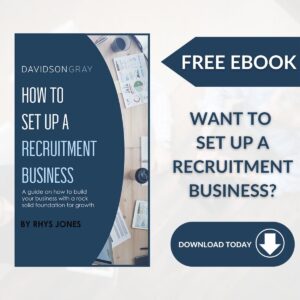
Get Rhys Jones’ comprehensive guide to starting up a recruitment business for free. Click the button below to access your pdf copy.
Don’t waste capital on vanity offices. Focus on establishing a digital infrastructure that makes you efficient, professional, and scalable from day one.
Your CRM houses your intellectual property. Avoid the classic trap of buying a system just because you used it at your previous job. Migrating databases later is an expensive nightmare, so choose wisely upfront.
Look for modern, automation-first, cloud-based setups.
Ensure it has solid mobile capabilities and integrates cleanly with your VoIP and email.
Read the full advice: How to Choose a CRM for Your New Recruitment Agency
If you are operating in a candidate-scarce, highly professional market, a premium LinkedIn tool is essential. However, you must understand your options to get a genuine return on investment (ROI).
Recruiter Lite: Good for tight budgets, but limits search visibility to 3rd-degree connections.
Full Recruiter (Corporate): Non-negotiable for scaling. It removes the blindfold by showing the entire global database, regardless of your personal network.
Read the comprehensive breakdown: A Guide to Using LinkedIn Recruiter
Most recruitment marketing is entirely useless. Brochure websites with stock images of people shaking hands do not generate business. Your website and branding should be a sophisticated lead-generation engine.
Position Yourself as an Authority: Share valuable insights, salary data, and niche content.
Inbound Lead Gen: True marketing builds a reputation so strong that clients and candidates come to you, transforming cold calls into warm inbound inquiries.
Listen to the podcast: Why Most Recruitment Companies Are Crap at Marketing
This is the least glamorous but most dangerous pillar to ignore. One compliance error can lead to former employers suing you, hefty GDPR fines, or unpaid fees due to faulty terms.
For a professional agency, a Limited Company is the only logical path.
Limited Liability: Protects your personal home, car, and savings from business debts or lawsuits.
Credibility: Major clients and corporate PSL panels will rarely do business with a sole trader.
Tax Efficiency: Allows you to structure your personal earnings via dividends rather than paying full income tax on all profits.
Many recruiters believe covenants “aren’t worth the paper they’re written on.” This is a dangerous lie. UK courts will enforce reasonable, well-drafted covenants that protect legitimate business interests.
Non-Solicitation: Prevents you from targeting your former employer’s active clients/candidates.
Non-Poach: Stops you from hiring your ex-colleagues.
Play It Smart: Set up quietly, build a fresh client base during your restricted period, and seek legal representation before resigning to locate loopholes.
Listen to the podcast: Restrictive Covenants for Recruiters: Myths vs. Reality
Offering shares is a fantastic way to attract and tie-in elite billers. However, giving away equity is a one-way street. Once handed over, it is highly complex to get back.
Shareholders’ Agreement: You must have a watertight document outlining bad-leaver clauses and dividend distribution.
Vesting Schedules: Never give away equity on day one. Ensure shares “vest” over 3 to 4 years or are tied strictly to hitting long-term billing milestones.
Read the guide: A Recruitment Consultant’s Guide to Understanding Equity and Shares
Do not call a single candidate until you have crossed these legal items off your list:
GDPR & ICO Registration: You must register with the Information Commissioner’s Office as a data controller.
Specialist Terms of Business: Watertight terms for Permanent and Contract placement drafted by a recruitment-specific solicitor.
Professional Indemnity & Employer Liability Insurances: Mandatory coverage required by most medium-to-large clients before you can do business with them.
Building a recruitment business is a highly rewarding path, but the operational setup is a monumental headache. When you launch alone, you aren’t just a recruiter; you are an IT tech, a collections clerk, a legal strategist, an accountant, and a marketing copywriter.
Every hour spent fighting with website servers, VAT returns, or insurance brokers is an hour you are not billing.
Building a recruitment business is a highly rewarding path, but the operational setup is a monumental headache. When you launch alone, you aren’t just a recruiter; you are an IT tech, a collections clerk, a legal strategist, an accountant, and a marketing copywriter. Every hour spent fighting with website servers, VAT returns, or insurance brokers is an hour you are not billing.
If you are ready for the next step in your journey, read our guide on scaling your recruitment business here.
Alternatively, if you’re ready to make the shift and want an experienced partner in your corner, book a confidential, no-obligation chat with Rhys to see how we can help you build the business you’ve always wanted.

Rhys provides the start-up infrastructure and all the support services your business will need, from finance to digital marketing, allowing you to focus on what you do best. He works directly with you to grow your business, offering as much mentoring and coaching as you need. When working together on the business’s growth strategy, much of the effort to deliver it can be delegated to the Davidson Gray team, giving you the support you need to scale faster and more effectively.
